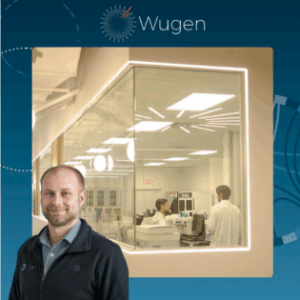
Matthew Cooper remembers vividly the day when his boss at Washington University Medical School came back from visiting a young patient who was dying of leukemia. Professor John DiPersio, distraught because he couldn’t help the child, said, “Matt, we have to go to the lab and come up with a cure.”
The two did just that. The lab work would eventually lead Cooper to found a company, Wugen, that’s developing a promising cell therapy for treating T-cell lymphoblastic leukemia and lymphoma, forms of cancer that have extraordinarily high mortality rates.
Wugen recently raised $115 million in venture capital to fund clinical studies that should, if all goes well, push its therapy across the finish line. The company expects to apply for Food and Drug Administration approval in 2027.
“It’s a hugely unmet medical need,” said Cooper, Wugen’s chief scientific officer. “Patients really have no therapeutic options now.”
He launched the company with funding from Clayton-based RiverVest Venture Partners and BioGenerator, the investment arm of nonprofit BioSTL. Without the money, and lab space provided by BioGenerator, the company probably would have moved elsewhere.
Instead, Wugen has become a standout among St. Louis biotech startups. It has raised more than $300 million in capital since 2018 and employs about 35 people at its headquarters in the Cortex district.
The path to success hasn’t been straightforward. When Wugen raised $172 million in 2021, investors were more excited about another cell therapy, which targeted solid tumors. Soon after, however, venture capitalists became reluctant to put more money behind unproven technologies that might face manufacturing challenges.
“Those were go-go days, but suddenly the pendulum swung and times have been difficult for biotech,” said Kumar Srinivasan, Wugen’s chief executive. “Cell therapy has been hit doubly hard.” Cooper believes the solid-tumor therapy is still viable, but his team pivoted and focused on WU-CART-007, the treatment for leukemia and lymphoma.
Wugen takes T-cells — an important component of the immune system — from healthy donors and edits their genes so they can target and destroy cancer cells. Crucially, the company figured out how to produce the cells in bulk. That wasn’t possible with earlier therapies, which took a patient’s own cells and modified them.
“Cell-based therapies are difficult to manufacture at scale,” said Niall O’Donnell, a RiverVest managing director who serves on Wugen’s board. “That’s been the real breakthrough and turning point for this therapy.”
The modified cells appear to work well. In small-scale trials, Wugen’s therapy achieved a 91% response rate and 73% remission rate.
And that’s among patients, Cooper said, who otherwise would have been likely to die within weeks. He said the last drug approved for these types of cancer, in 2005, had only a 22% response rate.
“To have a drug that works in 91% of people and gives the patients a chance at long-term survival is every scientist’s dream,” Cooper said.
If the larger clinical trial produces similar results, Wugen will be at a stage when many biotech startups get acquired by large drug companies. That’s a possible exit strategy, O’Donnell said, but the company also could pursue a public stock offering.
“If you have a market that is reasonably focused, such as a rare disease or rare cancer, you don’t actually need a full sales force,” O’Donnell said. “This market could be addressed by a standalone company.”
That decision, whether to sell or go it alone, is a couple of years away. Meanwhile, Wugen should be one of St. Louis’ most exciting startups to watch.
Contact
David Nicklaus is a retired Post-Dispatch columnist who continues to follow the St. Louis business scene. Contact him at dnickstl@gmail.com.